
Last updated: February 10, 2026
Live aquarium plants do far more than make your tank look beautiful. They absorb nitrates, produce oxygen, provide shelter for fish and fry, and help prevent algae growth by competing for the same nutrients. Whether you are setting up your first planted tank or looking to expand your plant collection, this guide covers the essentials.
Why Choose Live Plants Over Artificial Ones?
While artificial plants require no maintenance, they offer none of the biological benefits that live plants provide. Here is what real plants bring to your aquarium:
- Natural filtration: Plants absorb ammonia, nitrite, and nitrate, directly improving water quality
- Oxygen production: Through photosynthesis, plants release oxygen during the day, which is vital for fish respiration
- Algae control: By consuming excess nutrients, plants starve algae of the resources they need to bloom
- Natural behavior: Many fish species feel more secure and display more natural behavior when surrounded by plants
- Breeding habitat: Plants provide surfaces for egg-laying and hiding spots for fry
Beginner-Friendly Aquarium Plants
Not all aquatic plants require CO2 injection or high-intensity lighting. The species listed below thrive in moderate conditions and are readily available in Czech aquarium shops.
Java Fern (Microsorum pteropus)
Java fern is one of the easiest aquarium plants to grow. It should be attached to rocks or driftwood rather than planted in the substrate, as burying its rhizome will cause it to rot. It grows slowly but steadily and tolerates a wide range of water conditions.
- Lighting: Low to moderate
- CO2: Not required
- Growth rate: Slow
- Placement: Midground to background, attached to hardscape
Anubias (Anubias barteri)
Like Java fern, Anubias species attach to rocks and driftwood. They are incredibly hardy, tolerate low light, and their thick, dark green leaves are resistant to plant-eating fish. Anubias is perfect for shaded areas of the tank.
- Lighting: Low to moderate (too much light encourages algae on leaves)
- CO2: Not required
- Growth rate: Very slow
- Placement: Foreground to midground, attached to hardscape
Amazon Sword (Echinodorus bleheri)
The Amazon sword is a classic background plant with broad, bright green leaves that can grow quite large. It should be planted in nutrient-rich substrate and benefits from root tabs. In larger tanks, a mature Amazon sword makes a dramatic focal point.
- Lighting: Moderate to high
- CO2: Beneficial but not essential
- Growth rate: Moderate
- Placement: Background
Java Moss (Taxiphyllum barbieri)
Java moss is extremely versatile. It can be used to carpet surfaces, wrap driftwood, or create moss walls. It grows in virtually any conditions and provides excellent shelter for shrimp and fish fry. Czech aquarists often use it in breeding setups.
- Lighting: Low to high (adapts to nearly everything)
- CO2: Not required
- Growth rate: Moderate
- Placement: Anywhere; attach with fishing line or super glue gel
Cryptocoryne (various species)
Cryptocorynes, or "crypts," are a diverse group of plants with leaves ranging from green to brown to reddish. They are substrate-rooted plants that prefer stable conditions. A common issue with crypts is "crypt melt" when first introduced to a new tank, but they typically recover and grow back stronger.
- Lighting: Low to moderate
- CO2: Not required
- Growth rate: Slow to moderate
- Placement: Foreground to midground depending on species

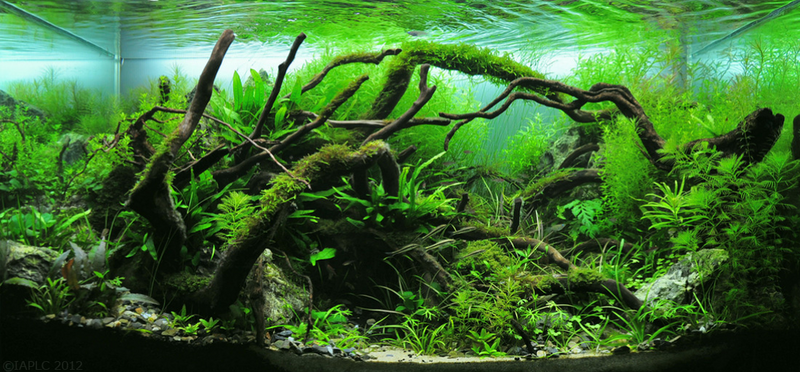
A home planted aquarium combining several beginner-friendly species for a natural, layered look.
Planting Techniques
Proper planting ensures your plants establish well and grow healthy:
- Substrate plants: Remove the plant from its pot, gently separate the roots, and plant them about 1-2 cm deep in the substrate. Do not bury the crown (where the stem meets the roots)
- Rhizome plants: Java fern and Anubias should be tied or glued to rocks or driftwood. Use aquarium-safe super glue gel or cotton thread
- Stem plants: Remove the lower leaves, trim the base at an angle, and insert the stems about 3 cm into the substrate. Space them 2-3 cm apart
- Moss: Spread thinly over the desired surface and secure with fishing line or mesh. Within a few weeks, it will attach naturally
Lighting and Fertilization
Light is the primary driver of plant growth. For a low-tech planted tank (no CO2 injection), aim for 6 to 8 hours of light per day. Using a timer ensures consistency and prevents algae from taking advantage of irregular lighting schedules.
Even low-tech plants benefit from occasional fertilization. Liquid fertilizers (such as Seachem Flourish or Tropica Specialised Nutrition) provide micronutrients, while root tabs supply nutrients directly to the root zone of heavy-feeding plants like Amazon swords.
Common Problems with Aquarium Plants
- Yellowing leaves: Often indicates iron or potassium deficiency. Address with liquid fertilizer
- Algae on leaves: Usually caused by too much light or excess nutrients. Reduce light hours and consider adding algae-eating species like nerite snails or otocinclus catfish
- Melting plants: Common when plants are first introduced. Most species recover once they adapt to new water parameters
- Slow growth: Check lighting intensity and duration. Consider adding root tabs for root-feeding plants